



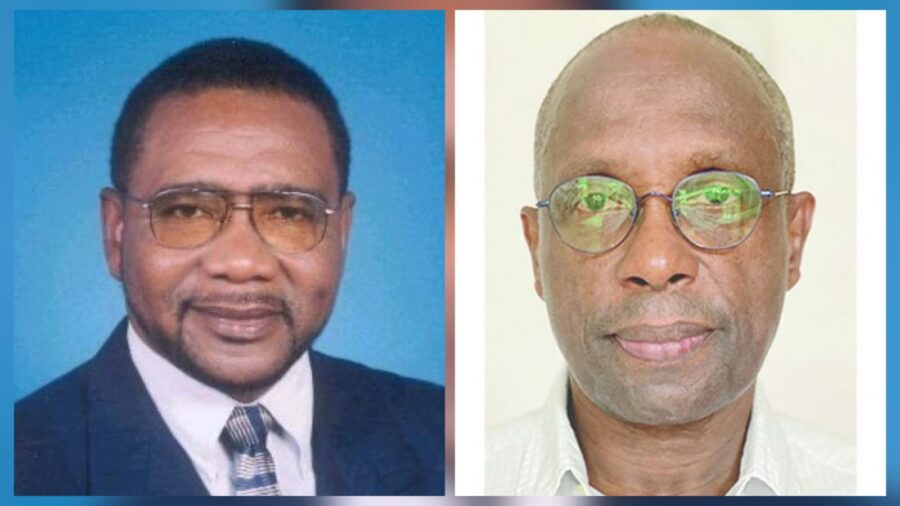

As Guyana reflects on the life and contributions of former PNCR Leader Robert Herman Orlando Corbin, who passed away on October 4, 2026, Dr. Henry Jeffrey revisits Corbin’s contribution to Guyana’s political and national development. Among the documents being highlighted, below, is Corbin’s 2003 address to the nation and the April 2003 “Constructive Engagement” agreement with then President Bharrat Jagdeo, which outlined proposals for political dialogue, democratic reform, equitable development and greater inclusion.
Part 1. ‘The future is now: bad governance!’
ADDRESS TO THE NATION BY MR. ROBERT H. O. CORBIN, M.P. LEADER OF THE PNCR on 17th August 2003
‘Fellow Guyanese: On 6th May 2003 last, many Guyanese breathed a sigh of relief and there was a new mood of optimism and expectancy when President Jagdeo and I finally signed the Communique that brought an end to the long political impasse. …
During that period the economic crisis continued and was characterized by the spiraling cost of living; unemployment; the closure of major businesses; rising levels of poverty; the flight of capital and Guyanese entrepreneurs and the decline of the social and economic conditions in many depressed and marginalized communities. Young people continued to lose hope in the future of our country. …
The frightening security situation witnessed a significant increase in violent crimes, murder, kidnapping, daring robberies, gangland style executions, and finally the shooting and killing of our policemen. This situation was preceded by other troubling developments such as the years of unabated extra judicial killings of hundreds of young people who were exterminated by the Black Clothes and other out-of-control elements in the Guyana Police Force and a highly suspicious and unexplained jailbreak by dangerous criminals.…
My Party and I contended then, as we do now, that the economic crisis was not a result of the political impasse, but a direct result of ill thought out, lopsided, incoherent and discriminatory policies. In short, bad governance…’
———————————————
‘Constructive Engagement’
Meeting between Mr. Bharrat Jagdeo, President of the Republic of Guyana and Mr. Robert Corbin, MP, the Leader of the People’s National Congress Reform on the
April 16th, 2003, at the Office of the President.
The President and Leader of the People’s National Congress Reform met at the Office of the President on April 16, 2003, and discussed a number of issues of national importance. Accordingly, all of the issues in question were discussed in an atmosphere of seriousness born of the recognition that there must be a determination to find solutions to them. Both parties understand that these issues go to the heart of Guyana’s socio development and must be urgently solved. They concluded that a ‘constructive engagement’ between the two Leaders can lead to timely resolution of difficulties and thus be of tremendous benefit to the political and economic development of Guyana. The Parties have therefore agreed to the following decisions.
Appointment of the Seven new Standing Committees of the National Assembly
The Parliamentary Management Committee:
President Jagdeo and the Leader of the PNCR have agreed to the composition and the appointment of the Parliamentary Management Committee. Accordingly, they took note of the fact that the Parties have named their representatives to this Committee and that a Motion has been placed on the Order Paper of the National Assembly. This Motion will be moved and debated at the next sitting of the National Assembly.
The Four Sector Committees:
The two Leaders had discussions and agreed on the composition and functioning of these Committees. They agreed that they are important to the effective functioning of Parliament, the overall democratic system, and the potential for the positive effect on the national economy, that their composition should not be delayed but should be agreed to with a minimum of delay. They took account of the fact that the PNCR has already submitted the names of its representatives to these Committees.
The two Leaders also noted that the Terms of Reference (TOR) for their appointment and composition of these Committees have been accepted by the representatives of the government, pending agreement on the question of non-Ministerial representation on the Committees.
1.1.2.2 Allocation of Ministerial Responsibilities on the four
Sector Committees:
The two Leaders reached agreement on the allocation of responsibilities on the Ministers of government on the Four Sector Committees. They further agreed that with the allocation of Ministerial responsibilities on these Committees, in conjunction with the appointment of representatives of other parties to the Committees, the ground will be lead for their effective functioning, given the expected understanding, mutual respect, national orientation and mature consideration in the context of the various issues that will be presented before the respective Committees.
Appointments Committee:
The two Leaders have agreed to the appointment of an Appointments Committee. They regard this as an important step as it is necessary that the Service Commissions be established so that important Public Service Appointments can be effected, including and especially that of a new Commissioner of Police.
1.1.3.2 Constitutional Reform Committee:
The names of the representatives of this Committee, having been agreed, the two Leaders stated their views that it can play an important role in the acceleration of the constitutional reform process, which is necessary for the strengthening and deepened of the democratic process in Guyana.
1.2 Strengthening the Capacity of the Parliament Office to Service Committees
Recognizing that the establishment and appointment of the seven Parliamentary Standing Committees can only function effectively if they are provided with the necessary human and other resources, the two Leaders noted that the provision of such resources will be the responsibility of the government. They also took account of the fact that budgetary provisions will be made to enable Parliament Office to service the needs of all of the Committees.
1.2.2 Research and Documentation Support
Research and documentation support are also essential to the work of the Committees concerned and the two Leaders therefore agreed that, supported by the requisite provision by the Parliament Office, there should be qualified and competent research staff, including a senior professional researcher, who would function as “Research Co-ordinator”, and who would be supported by two professional researchers. This arrangement should be subject to early review after the Committees have begun their work.
The two Leaders also agreed that with regard to the Foreign Relations Committee, and where necessary other Committees, the Opposition Parties will have access to information which might be in the possession of government Ministries and Agencies, so that they can execute their responsibilities with efficiency.
Remuneration of MPs
The two Leaders recognized that Members of Parliament, including Regional MPs, must be adequately remunerated for their services rendered in respect of servicing on the Committees under consideration and stated that existing statutory provisions which are in existence must accommodate this need.
1.3 Establishment of the Ethnic Relations Commission
The Leader of the PNCR and President Bharrat Jagdeo considered the question of the Ethnic Relations Commission in the context of the perceived need to remove the taint of racial discrimination and ethnic insecurity and to create the conditions that can endure harmonious relations among the races of Guyana and thereby remove a factor which makes for instability and tension.
They considered the establishment of this Commission as an important matter and declared that its work must at all times be professional, sensitive and conducted in the national interests of the nation.
1.4.1 Public Procurement Commission
The efficient conduct of the work of the Tender Board was discussed by the two Leaders and they examined the matter in the context of the requirement for the appointment of members to the Public Procurement Commission, the creation of which was recommended by the Constitution Reform Commission.
They expressed their satisfaction that the members have now been appointed and that its composition and work could remove a source of irritation between the various stakeholders in society. Equally, they were of the view that this Commission, by its work and its sensitive performance of its duties, can have an improving effect on the political climate and the economic position of this society.
The Rights Commissions
- The Human Rights Commission
- Women and Gender Equity Commission
- Indigenous Peoples’ Commission
- The Rights of the Child Commission
Both Leaders took note of the fact that to effect the operations of these Commissions by way of nomination and appointment must be realized by a Consensual Mechanism, which has to be determined by the National Assembly.
They therefore urged Members of the National Assembly to approve such a mechanism so that the work of these Committees can begin without any further delay. In this regard, they stated their views that a strengthening of the rights of the citizens of Guyana in every respect can strengthen the social bases of the society.
Implementation of Decisions of the Joint Committees
The two Leaders passed in review the decisions outstanding from the six joint committees established in the context of the dialogue between former Leader of the PNCR, Mr. Hugh Desmond Hoyte, and Mr. Bharrat Jagdeo and agreed that the actions inherent in the submissions made by the relevant Government functionaries should be expedited.
National Policy on Land and House Lots Distribution
The discussions on the question of the distribution of house lots was given extensive treatment and the two Leaders concluded that the Policy Paper needs to undergo revision in order to accommodate the concerns of the People’s National Congress Reform that such distribution must be done according to clear, transparent and equitable criteria.
They also agreed that there must be monitoring of the distribution of land to ensure compliance with such criteria and the investigation of complaints based on discrimination.
They further agreed that there should be a freeze on the distribution of land until the stated criteria and other mechanisms specified by the National Assembly are in place according to the law.
They finally agreed that the Joint Committee should be re-established to, among other things, supervise the implementation of the system specified by the National Assembly for the transparent and equitable distribution of land and house lots.
Local Government Reform
The Leader of the PNCR, Mr. Robert Corbin, and President Jagdeo examined the question of Local Government Reform and noted that the Joint Committee established in this regard had been unable to complete its work and submit a final report before the stated deadline.
In the circumstances, they agreed that the committee should be re-established and provided with adequate support and resources, so that it can complete all of the tasks and responsibilities assigned to it.
The two Leaders were of the view that the Joint Committee should consider that the electoral system for future Local Government Elections must be a priority and that the committee must develop a suitable system and appropriate procedures for compulsory annual fiscal transfers to underwrite the autonomy of Local Government Organs.
The committee would also determine the Terms of Reference for an independent constitutional Local Government Commission. Legislation for the implementation of all agreed Local Government Reforms should be prepared and presented to the National Assembly within six months.
2.3 Depressed Communities
Having examined this matter, which was first given consideration by the committee established during the dialogue between Mr. Hugh Desmond Hoyte and Mr. Bharrat Jagdeo, the two Leaders concluded that all projects agreed for the Phase I communities should be completed within one month.
The allocation of G$608 million for the implementation of projects already identified and agreed for the Phase II communities must be released immediately.
The two Leaders also agreed that there must be, within a period of six months, a comprehensive programme, including the necessary financial requirements, for addressing the problems of all depressed communities in Guyana.
2.4 Radio Monopoly and Non-Partisan Boards
On examination of this matter, the two Leaders concluded that the non-partisan management of the state-owned media, using guidelines agreed by the Joint Committee, should be implemented immediately.
They also considered the draft legislation for comprehensive Media Reform, including the establishment of a National Broadcast Authority, and agreed that it should be submitted to the Joint Committee within one month for agreement prior to being laid in the National Assembly.
The two Leaders also came to the agreement that equitable access to the state-owned media should be established immediately and an independent National Broadcast Authority should be realized within three months.
Private radio broadcast licences should be issued immediately after consideration and approval by the Joint Committee pending the establishment of the independent National Broadcast Authority.
With regard to the National Frequency Management Unit, the two Leaders agreed that this body should be brought under the control and supervision of the National Broadcast Authority as soon as it is established.
Accordingly, there should be a freeze on the grant of all frequencies by the NFMU until such time as it comes under the control of the NBA.
The NBA, the Leaders also agreed, should be asked to give priority to arrangements for the granting of radio broadcast licences on the basis of statutorily determined criteria.
Finally, on this question, the two Leaders decided that the Interim Broadcast Committee should be disbanded immediately.
Border and National Security Issues, Including the Recapitalization of the GDF
In examining this question, the two Leaders noted that the Joint Committee’s report was submitted as long ago as July 2002 to the Ministry of Foreign Affairs for editing prior to being laid in the National Assembly, and concluded in the circumstances that the committee’s report should be laid in the National Assembly forthwith.
They also concluded that the Joint Committee should be re-established to oversee the implementation of the recommendations contained in the report.
2.6 Bauxite Industry and Communities Resuscitation
The rapidly deteriorating social and economic conditions in Region 10 claimed the attention of the two Leaders and they accordingly reached agreement on the need for a comprehensive development programme that would address in that Region such matters as the creation of new employment opportunities; rehabilitation and satisfactory functioning of all public utilities; the establishment of an incentives regime for the attraction of inward investment to the Region; the creation of a fully supportive institutional environment for small and medium-scale business development by the inhabitants of the Region; and the immediate establishment of transparent and equitable criteria for the Regional Administration to distribute land and house lots; and any other areas considered critical.
The Appointment of PNCR Nominees to State Boards and Committees
This matter was examined by the two Leaders, and it was agreed that the following principles would apply:
- The Government would provide the PNCR with a complete list of all State Boards, Commissions and Committees.
- All Boards, Commissions and Committees on that list should be available to the PNCR for nominations.
- The Government undertakes to invite PNCR to submit nominees for all Boards, Commissions and Committees which are due for appointment in 2003.
- The PNCR will be given three months’ notice of all Boards, Commissions and Committees which are to be appointed after 2003.
2.8 Commission of Inquiry into the Operations of the Guyana Police Force
The two Leaders investigated the question of the appointment of a Commission of Inquiry into the operations of the Guyana Police Force and concluded that the power to do so vests in the President in accordance with the Commission of Inquiry Act, Cap. 19:03.
It was also noted that Article 197(5) gives the President such powers. It was therefore agreed that the required Commission of Inquiry could be facilitated by way of a constitutional amendment to the former Article and this would obviate unnecessary and undesirable delays in creating such a Commission of Inquiry.
The Leaders also agreed that Terms of Reference (TOR) for such an inquiry should be developed with a minimum of delay.
2.9 Public Service Commission
The two Leaders found that it is an acceptable proposition that in the interest of efficiency the Public Service should be depoliticised, as previously agreed in the dialogue between Mr. Hugh Desmond Hoyte and Mr. Bharrat Jagdeo, and that this can only eventuate by the removal of identified political Permanent Secretaries and appointment to these positions by professionally qualified career public servants.
The two Leaders took note of the fact that the practice of recruiting persons on contract to fill establishment posts in the Public Service was detrimental to efficiency and unfair to career public servants who expect to benefit from the service in terms of expectation of upward mobility within the structure of the service.
Georgetown
15th April 2003
Source: Village Voice News



