




Venezuela border controversy: ICJ ruling can usher in new era of Guyana-Venezuela relations – Pres Ali tells UN
– says Guyana went to ICJ after decades of bilateral efforts
– urges Venezuela to abide by upcoming ruling as interim President calls for fresh negotiations
– urges Venezuela to abide by upcoming ruling as interim President calls for fresh negotiations
With the International Court of Justice (ICJ) expected to deliver a decision in the coming months on the border controversy between Guyana and Venezuela, President Dr Irfaan Ali has renewed calls for the Spanish-speaking nation to abide by the court’s decision, saying that it will set the stage for new neighbourly relations.
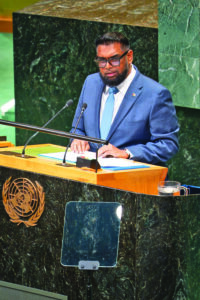
The Guyanese leader made remarks during his address at the 81st United Nations General Assembly on Thursday in New York, United States.
“We urge Venezuela to abide by the forthcoming ruling in accordance with their obligation under the UN Charter, as Guyana will do. We look forward to a new era of neighbourly relations in the interest of our peoples, the development of our countries, and the stability and prosperity of our region,” President Ali stated.
His comments come just one day after his Venezuelan counterpart, acting President Delcy Rodriguez, called for the two neighbouring nations to return to the negotiation table to settle the decades-long border controversy, even as she reaffirmed her country’s claims to two-thirds of Guyana’s 83,000 square miles.
“Here, I appeal to the Cooperative Republic of Guyana to resolve the issue and to return to negotiations as stipulated by the Geneva Agreement,” Rodriguez stated during her address to the UN Assembly, even as she wore a brooch that contained Guyana’s Essequibo region as part of the Venezuelan map.
According to the interim Venezuelan President, “Agreements that last the longest are those that emerge from bilateral negotiations. They last longer and function better than those imposed by external bodies.”
“We urge Venezuela to abide by the forthcoming ruling in accordance with their obligation under the UN Charter, as Guyana will do. We look forward to a new era of neighbourly relations in the interest of our peoples, the development of our countries, and the stability and prosperity of our region,” President Ali stated.
His comments come just one day after his Venezuelan counterpart, acting President Delcy Rodriguez, called for the two neighbouring nations to return to the negotiation table to settle the decades-long border controversy, even as she reaffirmed her country’s claims to two-thirds of Guyana’s 83,000 square miles.
“Here, I appeal to the Cooperative Republic of Guyana to resolve the issue and to return to negotiations as stipulated by the Geneva Agreement,” Rodriguez stated during her address to the UN Assembly, even as she wore a brooch that contained Guyana’s Essequibo region as part of the Venezuelan map.
According to the interim Venezuelan President, “Agreements that last the longest are those that emerge from bilateral negotiations. They last longer and function better than those imposed by external bodies.”
Recourse to World Court
But President Ali on Thursday reminded us that it was under that very Geneva Agreement that the UN Secretary General (UNSG) referred the border controversy to be settled by the World Court.
“The matter was referred to the International Court of Justice by the Secretary General, acting pursuant to the Geneva Agreement… Recourse to the ICJ came after decades of efforts to resolve the controversy bilaterally, including through a mixed commission and the Good Offices of the UNSG. In full respect for international law, Guyana participated and encouraged Venezuela to participate in the proceedings of the ICJ. Now that we have both participated in the hearings, which were completed in May 2026, we urge Venezuela to abide by the forthcoming ruling.”
“Guyana has always advanced the peaceful settlement of the controversy regarding our border with Venezuela. Despite the historical truth – clearly outlined in the Arbitral Award of 1899 that determined the full, perfect, and final settlement of our border with Venezuela – we endured long and repeated provocations and aggression,” the Guyanese Head of State noted.
Venezuela is seeking claims to more than two-thirds of Guyana’s landmass and a section of the country’s Exclusive Economic Zone (EEZ).
But President Ali on Thursday reminded us that it was under that very Geneva Agreement that the UN Secretary General (UNSG) referred the border controversy to be settled by the World Court.
“The matter was referred to the International Court of Justice by the Secretary General, acting pursuant to the Geneva Agreement… Recourse to the ICJ came after decades of efforts to resolve the controversy bilaterally, including through a mixed commission and the Good Offices of the UNSG. In full respect for international law, Guyana participated and encouraged Venezuela to participate in the proceedings of the ICJ. Now that we have both participated in the hearings, which were completed in May 2026, we urge Venezuela to abide by the forthcoming ruling.”
“Guyana has always advanced the peaceful settlement of the controversy regarding our border with Venezuela. Despite the historical truth – clearly outlined in the Arbitral Award of 1899 that determined the full, perfect, and final settlement of our border with Venezuela – we endured long and repeated provocations and aggression,” the Guyanese Head of State noted.
Venezuela is seeking claims to more than two-thirds of Guyana’s landmass and a section of the country’s Exclusive Economic Zone (EEZ).
Back in March 2018, Guyana approached the ICJ seeking a final and binding settlement of the 1899 Arbitral Award, which demarcated the boundary with Venezuela.
The Spanish-speaking nation is laying claims to more than two-thirds of Guyana’s landmass and a portion of the country’s Exclusive Economic Zone (EEZ), where over 11 billion barrels of oil equivalent (boe) have been found, and production as well as other exploration activities are ongoing.
Back in 2018, and based on the recommendation of UNSG António Guterres following years of failed diplomacy between the two countries, Guyana had approached the ICJ, seeking a final and binding settlement of the 1899 Arbitral Award, which establishes the boundaries with Venezuela.
The case wrapped up back in May of this year after both countries were given two opportunities to make oral arguments on the merits of their respective cases at the Peace Palace in The Hague, Netherlands. The ICJ is now deliberating on its decision, which is expected to be delivered early in the new year.
President Ali had previously said that the ICJ’s pending ruling will give finality to the border controversy with Venezuela, and Guyana will wait with patience and dignity for that decision – something of which he is confident will be in his country’s favour.
The Spanish-speaking nation is laying claims to more than two-thirds of Guyana’s landmass and a portion of the country’s Exclusive Economic Zone (EEZ), where over 11 billion barrels of oil equivalent (boe) have been found, and production as well as other exploration activities are ongoing.
Back in 2018, and based on the recommendation of UNSG António Guterres following years of failed diplomacy between the two countries, Guyana had approached the ICJ, seeking a final and binding settlement of the 1899 Arbitral Award, which establishes the boundaries with Venezuela.
The case wrapped up back in May of this year after both countries were given two opportunities to make oral arguments on the merits of their respective cases at the Peace Palace in The Hague, Netherlands. The ICJ is now deliberating on its decision, which is expected to be delivered early in the new year.
President Ali had previously said that the ICJ’s pending ruling will give finality to the border controversy with Venezuela, and Guyana will wait with patience and dignity for that decision – something of which he is confident will be in his country’s favour.
Peaceful resolution of global conflicts
Meanwhile, the Guyanese leader’s push for a peaceful settlement of the border controversy with Venezuela aligns with Guyana’s longstanding position for the stability and prosperity of the region.
In fact, he used the opportunity to call for an end to the crises facing countries within the Latin American and Caribbean region. In Haiti, he said resolving the multidimensional challenges remains central to achieving democracy, stability, peace, and prosperity for the Haitian people.
According to Ali, the sustained support of the international community through the provision of key financial and material resources is critical to realising these objectives. However, he stressed that the future of Haiti must ultimately be Haitian-led and Haitian-owned.
Similarly, he reiterated calls for a viable solution for Cuba – one that is peaceful, people-centred, development-focused, and allows for the full aspirations of the Cuban people to be realised. He underscored the Caribbean Community’s (CARICOM’s) offer to play a meaningful role in achieving this objective.
Turning his attention to ongoing conflicts around the world, the Guyanese leader renewed Guyana’s call for a just and lasting solution to the crisis in the Middle East that will not only bring an end to the suffering of innocent civilians but also recognize the Palestinian people’s legitimate right to self-determination and to a secure homeland of their own.
“We reiterate our support for the two-state solution,” President Ali posited. In the same breath, he also advocated for an end to the Russia-Ukraine war and the war in Sudan and for a peaceful resolution of all conflicts that continue to consume lives, uproot families, and extinguish the hopes of millions in other parts of our world.
“We have the possibility of silencing the guns through dialogue and diplomacy. The world does not need more sophisticated instruments of destruction; it needs a more sophisticated capacity for peace,” the head of state noted.
Meanwhile, the Guyanese leader’s push for a peaceful settlement of the border controversy with Venezuela aligns with Guyana’s longstanding position for the stability and prosperity of the region.
In fact, he used the opportunity to call for an end to the crises facing countries within the Latin American and Caribbean region. In Haiti, he said resolving the multidimensional challenges remains central to achieving democracy, stability, peace, and prosperity for the Haitian people.
According to Ali, the sustained support of the international community through the provision of key financial and material resources is critical to realising these objectives. However, he stressed that the future of Haiti must ultimately be Haitian-led and Haitian-owned.
Similarly, he reiterated calls for a viable solution for Cuba – one that is peaceful, people-centred, development-focused, and allows for the full aspirations of the Cuban people to be realised. He underscored the Caribbean Community’s (CARICOM’s) offer to play a meaningful role in achieving this objective.
Turning his attention to ongoing conflicts around the world, the Guyanese leader renewed Guyana’s call for a just and lasting solution to the crisis in the Middle East that will not only bring an end to the suffering of innocent civilians but also recognize the Palestinian people’s legitimate right to self-determination and to a secure homeland of their own.
“We reiterate our support for the two-state solution,” President Ali posited. In the same breath, he also advocated for an end to the Russia-Ukraine war and the war in Sudan and for a peaceful resolution of all conflicts that continue to consume lives, uproot families, and extinguish the hopes of millions in other parts of our world.
“We have the possibility of silencing the guns through dialogue and diplomacy. The world does not need more sophisticated instruments of destruction; it needs a more sophisticated capacity for peace,” the head of state noted.
Discover more from Guyana Times
Subscribe to get the latest posts sent to your email.
Source: Guyana Times
Contents
– says Guyana went to ICJ after decades of bilateral efforts
– urges Venezuela to abide by upcoming ruling as interim President calls for fresh negotiationsWith the International Court of Justice (ICJ) expected to deliver a decision in the coming months on the border controversy between Guyana and Venezuela, President Dr Irfaan Ali has renewed calls for the Spanish-speaking nation to abide by the court’s decision, saying that it will set the stage for new neighbourly relations.The Guyanese leader made remarks during his address at the 81st United Nations General Assembly on Thursday in New York, United States.
“We urge Venezuela to abide by the forthcoming ruling in accordance with their obligation under the UN Charter, as Guyana will do. We look forward to a new era of neighbourly relations in the interest of our peoples, the development of our countries, and the stability and prosperity of our region,” President Ali stated.
His comments come just one day after his Venezuelan counterpart, acting President Delcy Rodriguez, called for the two neighbouring nations to return to the negotiation table to settle the decades-long border controversy, even as she reaffirmed her country’s claims to two-thirds of Guyana’s 83,000 square miles.
“Here, I appeal to the Cooperative Republic of Guyana to resolve the issue and to return to negotiations as stipulated by the Geneva Agreement,” Rodriguez stated during her address to the UN Assembly, even as she wore a brooch that contained Guyana’s Essequibo region as part of the Venezuelan map.
According to the interim Venezuelan President, “Agreements that last the longest are those that emerge from bilateral negotiations. They last longer and function better than those imposed by external bodies.”Recourse to World Court
But President Ali on Thursday reminded us that it was under that very Geneva Agreement that the UN Secretary General (UNSG) referred the border controversy to be settled by the World Court.
“The matter was referred to the International Court of Justice by the Secretary General, acting pursuant to the Geneva Agreement… Recourse to the ICJ came after decades of efforts to resolve the controversy bilaterally, including through a mixed commission and the Good Offices of the UNSG. In full respect for international law, Guyana participated and encouraged Venezuela to participate in the proceedings of the ICJ. Now that we have both participated in the hearings, which were completed in May 2026, we urge Venezuela to abide by the forthcoming ruling.”
“Guyana has always advanced the peaceful settlement of the controversy regarding our border with Venezuela. Despite the historical truth – clearly outlined in the Arbitral Award of 1899 that determined the full, perfect, and final settlement of our border with Venezuela – we endured long and repeated provocations and aggression,” the Guyanese Head of State noted.
Venezuela is seeking claims to more than two-thirds of Guyana’s landmass and a section of the country’s Exclusive Economic Zone (EEZ).Back in March 2018, Guyana approached the ICJ seeking a final and binding settlement of the 1899 Arbitral Award, which demarcated the boundary with Venezuela.
The Spanish-speaking nation is laying claims to more than two-thirds of Guyana’s landmass and a portion of the country’s Exclusive Economic Zone (EEZ), where over 11 billion barrels of oil equivalent (boe) have been found, and production as well as other exploration activities are ongoing.
Back in 2018, and based on the recommendation of UNSG António Guterres following years of failed diplomacy between the two countries, Guyana had approached the ICJ, seeking a final and binding settlement of the 1899 Arbitral Award, which establishes the boundaries with Venezuela.
The case wrapped up back in May of this year after both countries were given two opportunities to make oral arguments on the merits of their respective cases at the Peace Palace in The Hague, Netherlands. The ICJ is now deliberating on its decision, which is expected to be delivered early in the new year.
President Ali had previously said that the ICJ’s pending ruling will give finality to the border controversy with Venezuela, and Guyana will wait with patience and dignity for that decision – something of which he is confident will be in his country’s favour. Peaceful resolution of global conflicts
Meanwhile, the Guyanese leader’s push for a peaceful settlement of the border controversy with Venezuela aligns with Guyana’s longstanding position for the stability and prosperity of the region.
In fact, he used the opportunity to call for an end to the crises facing countries within the Latin American and Caribbean region. In Haiti, he said resolving the multidimensional challenges remains central to achieving democracy, stability, peace, and prosperity for the Haitian people.
According to Ali, the sustained support of the international community through the provision of key financial and material resources is critical to realising these objectives. However, he stressed that the future of Haiti must ultimately be Haitian-led and Haitian-owned.
Similarly, he reiterated calls for a viable solution for Cuba – one that is peaceful, people-centred, development-focused, and allows for the full aspirations of the Cuban people to be realised. He underscored the Caribbean Community’s (CARICOM’s) offer to play a meaningful role in achieving this objective.
Turning his attention to ongoing conflicts around the world, the Guyanese leader renewed Guyana’s call for a just and lasting solution to the crisis in the Middle East that will not only bring an end to the suffering of innocent civilians but also recognize the Palestinian people’s legitimate right to self-determination and to a secure homeland of their own.
“We reiterate our support for the two-state solution,” President Ali posited. In the same breath, he also advocated for an end to the Russia-Ukraine war and the war in Sudan and for a peaceful resolution of all conflicts that continue to consume lives, uproot families, and extinguish the hopes of millions in other parts of our world.
“We have the possibility of silencing the guns through dialogue and diplomacy. The world does not need more sophisticated instruments of destruction; it needs a more sophisticated capacity for peace,” the head of state noted.Discover more from Guyana Times



