




…fresh equipment, suspended staff, and a manager’s sudden return
By Khadidja Ba
(Kaieteur News) – On Thursday morning, members of the Commission of Inquiry (COI) investigating the MV Barima tragedy descended upon the Transport and Harbours Department (THD) Kingston Wharf for a scheduled on-site inspection. What greeted the delegation of officials, maritime auditors, and media practitioners was a scene of pristine order and swift upgrades, a contrast to the historical realities described by staff who have laboured at the facility for years.

Commissioners checking the bond

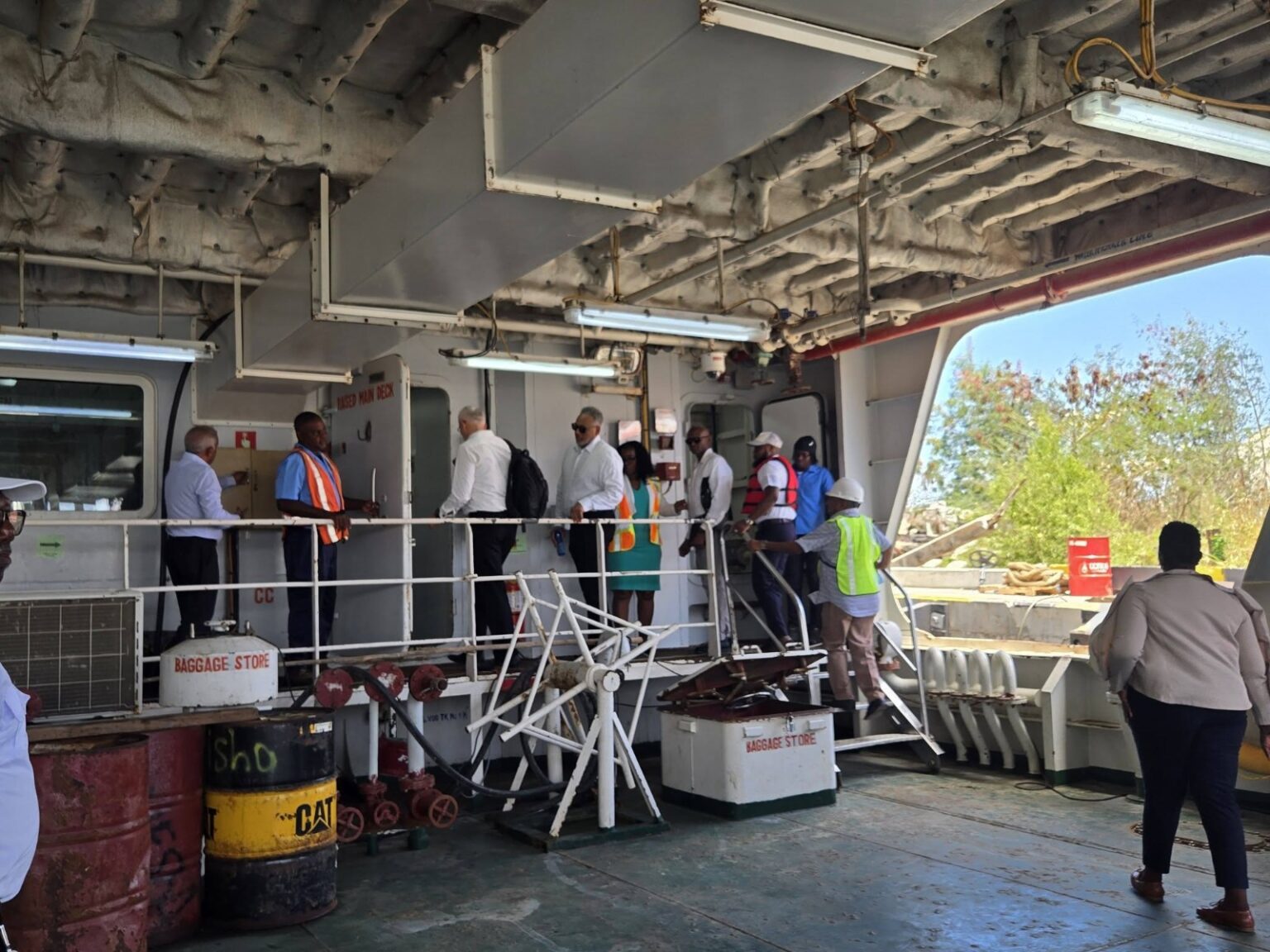
Commissioners inspecting the MV MaLisha.
The Kingston Wharf serves as the departure point for ferries plying the North West route, including the MV Barima, which departed from that very site on 18th July prior to its deadly voyage. During the walk-through, commissioners inspected the cargo bond, the passenger waiting room, and vessels currently docked at the facility, including the MV MaLisha and the MV Kimbia. Jamaica-based maritime expert and compliance auditor Captain Hamada Fouda, one of five commissioners conducting the probe, was observed examining the exterior and interior of the MV Malisha while colleagues reviewed operational facilities. He was seen on more than one occasions taking photographs and notes of the rusted and broken sections of the vessel. Throughout the tour, members of the Commission frequently remarked on the seemingly immaculate conditions. Inspecting a weighing scale on the wharf, one commissioner remarked aloud “This is brand new.”

“This is new!” Commissioners observing a newly installed scale
However, photographic evidence and eyewitness accounts from the ground suggest that the scene presented to the Commission was a hastily assembled veneer. Photographs captured during a prior media visit on 4th August, as the MV Malisha prepared to leave Georgetown, show a waiting area and wharf perimeter devoid of the infrastructure, and paved surfaces visible today.
“All of this was done a month or so ago after the boat sank,” a worker at the facility remarked, pointing toward freshly installed wall fans in the waiting area and newly paved ground where stagnant pools of water once sat. “You were here and saw the state of this place. We worked in a deplorable state for years. All this you are seeing now is a ‘new’ THD… Soon as the vessel sank, we got a road and everything.”

Waiting area with fans October 2026, there were no fans when KN visited in August 2026.
Inside the cargo bond, long-time workers noted that several pieces of handling gear, signage and structural arrangements were put in place mere days ago. “Everything you see in there in the bond is what was implemented yesterday and Monday,” one source disclosed, noting that prior to the installation of the scale occurred approximately two months ago, cargo measurements were routinely conducted without one. The inspection was further marked by the unexpected presence of senior management and the noticeable absence of key operational staff who were present on the day of the disaster.
Transport and Harbours Manager Yerlander Hughes was seen walking alongside the Commission, guiding them through the bond and passenger areas. When pressed by reporters regarding the sudden arrival of new fixtures and equipment at the Kingston Wharf, Hughes offered only a terse “No comment.” Observers on the ground noted that Hughes was accompanied by the Department’s Marine Superintendent Corwayne Stephens, the official to whom distress signals, logs, and formal letters written by the vessel’s captain and crew were directed prior to the sinking. Staff members expressed frustration at seeing senior officers overseeing the walkthrough while lower-level employees faced the brunt of administrative action.

Captain Fouda dusting his hand off from the rust.
“The supervisor and operator who worked on the day of the sailing…they know the operation inside out and all of them sent on Administrative leave, they just didn’t want them man talking the truth,” another staffer remarked, questioning why suspended crew and dock personnel were sidelined while executive officers guided the inquiry’s walkthrough.
As the inspection concluded and media representatives were asked to give the delegation space, members of the Commission remained tight-lipped regarding their initial findings during that section. When asked whether the recent infrastructural additions would alter the Commission’s assessment of historical safety compliance at the wharf, Chairperson Godfrey Smith declined to comment on specific observations, stating simply: “We are working and gathering evidence.”
The Commission’s site visits are scheduled to continue to dry docking facilities as the panel sifts through operational records, maintenance logs, and witness testimonies to determine the sequence of failures that led to the MV Barima disaster.
Source: Kaieteur News



