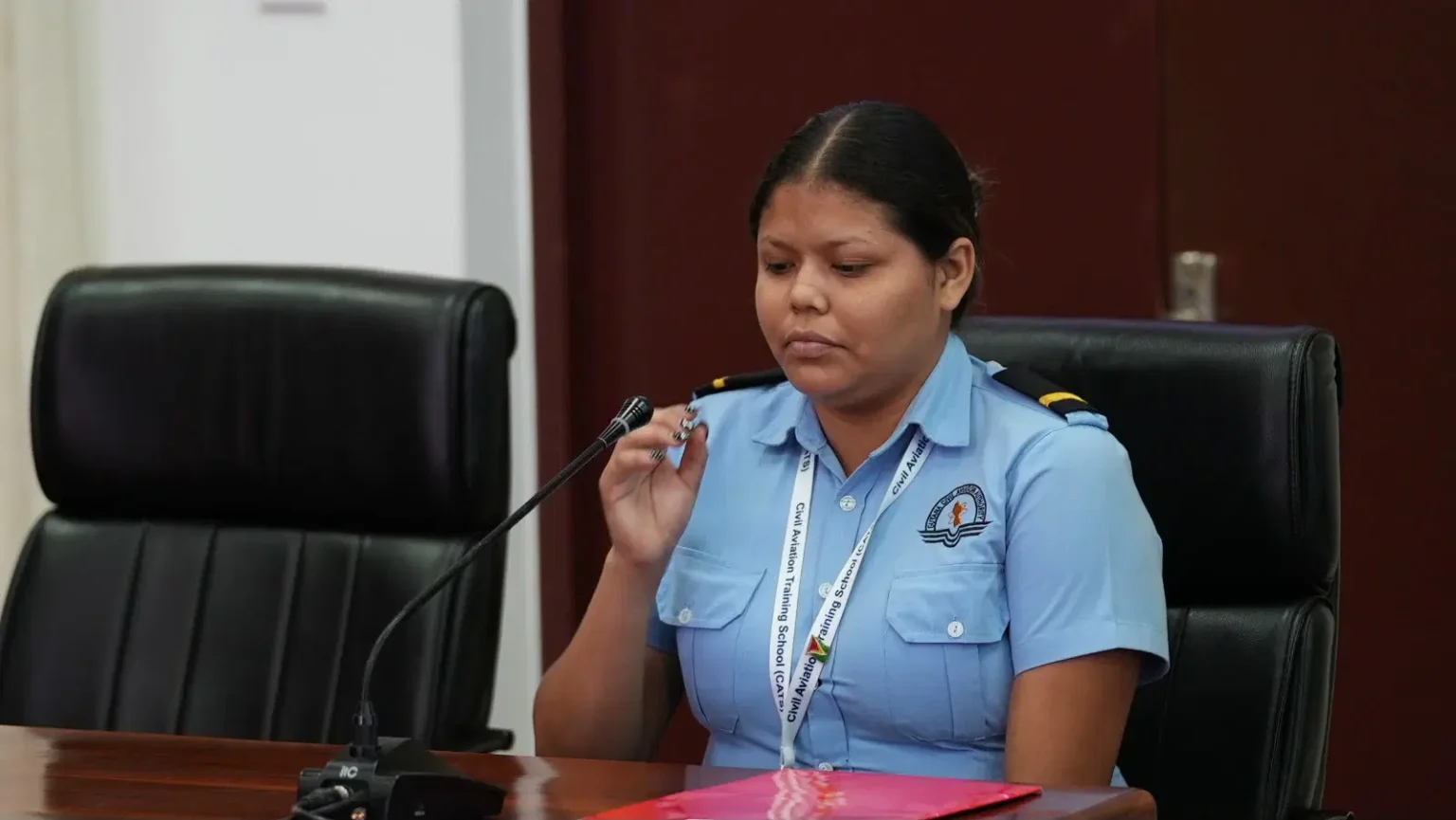

Tia Valenzuela, an Aeronautical Information Service (AIS) officer, told the Commission of Inquiry (COI) into the MV Barima tragedy that she alerted the Guyana Defence Force (GDF) Coast Guard by WhatsApp just minutes after receiving a distress signal from the sinking vessel, with the Coast Guard responding within a minute.
Valenzuela gave sworn testimony as the Commission began hearings on Wednesday, detailing the procedures she followed after a distress alert appeared on the Guyana Civil Aviation Authority’s aeronautical message-handling system.
Valenzuela testified that she was on duty between 16:00 hrs and midnight on July 18. She was working alongside two trainees, while another staff member had obtained permission from a supervisor to leave early.
At approximately 22:43 hrs., while seated at her desk, she heard a continuous beeping sound from the distress message mailbox.
“When the beeping was received, I checked the system and I saw it was a distress alert message,” she told the Commission.
After checking the message, she identified it as an Emergency Position-Indicating Radio Beacon (EPIRB), which is associated with maritime distress alerts.
She explained that the usual procedure upon receiving a distress message was to print the report, plot the coordinates and enter the information into a website to determine whether the beacon had a registered owner and whether it was associated with an aircraft or a maritime vessel.
The process involves using SkyVector to map the beacon’s location before transmitting the information through the established communication channels.
Valenzuela said that after completing the coordinates from the message, she sent the information to the GDF Coast Guard via WhatsApp at 22:51 hrs The Coast Guard responded at 22:52 hrs, according to her testimony. She explained that the procedure requires officers to contact the GDF by telephone if there is no response within a minute of the initial communication.
In addition to alerting the Coast Guard, Valenzuela said the information is sent to other relevant parties, including the lighthouse and the commanding officer of GDF coast David Shamsudeen, along with a report from the United States Mission Control Centre (US MCC). An email containing the information is also sent to the GDF.
Valenzuela testified that the initial alert was followed by multiple other distress messages containing additional coordinates. As the messages came in, she also had to respond to the US Mission Control Centre, providing the time she received each message and the time it was sent by the centre.
She further explained that the beacon’s hexadecimal identification number, or Hex ID, is generally used to identify its owner. However, the Commission had previously heard that the beacon involved in the incident was not registered. Because the beacon was unregistered, Valenzuela said she could not contact an owner to obtain additional information.
Source: NEW ROOMS SITE