





…says current structure maximizes value for the country
(Kaieteur News) – After almost six years of producing oil, Guyana is now finally enjoying a greater share of profits from the Stabroek Block as the investments made by ExxonMobil have been recovered.
The company is however chasing approval from government for an additional two projects that could again cause Guyana’s profits to slide from the current 39.8% to just 12.5% if the Government of Guyana (GoG) fails to ring-fence these upcoming developments.
Ring-fencing the projects would prevent Exxon from using profits that should flow into the Natural Resource Fund (NRF) or Guyana’s oil account to finance the developments.
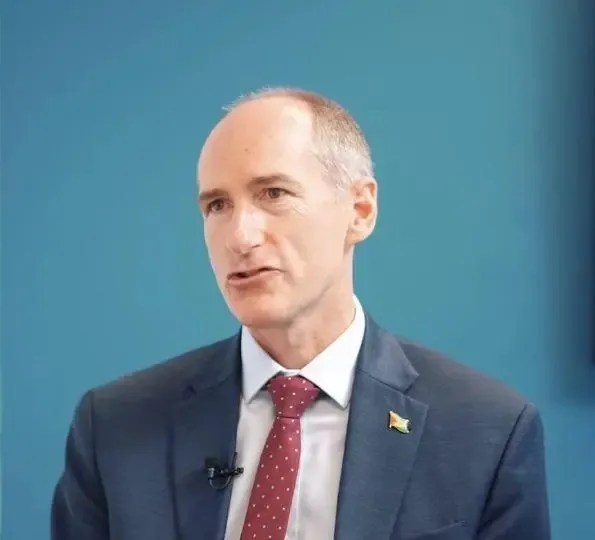
ExxonMobil Guyana President, Alistair Routledge
President Irfaan Ali has committed to seeking expert advice on whether there should be changes to the current financing arrangement that allows ExxonMobil to delay Guyana’s profits to pay for these projects but the President of ExxonMobil Guyana Limited (EMGL), Alistair Routledge is fiercely against any changes.
During an Energy Luncheon hosted by the Georgetown Chamber of Commerce and Industry (GCCI) on Thursday, Routledge in remarks recognised calls echoing across the country for ring-fencing of future projects. While he acknowledged that countries around the world have applied this provision, the Exxon representative said nations with deepwater basins like Guyana should be cautious.
“Some have raised questions about ring-fencing. Should every project be ring-fenced? In some places that happens. I would say in deep water, which is what we are talking about here, that is something we should be cautious about,” he said.
Routledge went on to explain that if Guyana had ring-fenced each project, it would have “seriously undermined” the company’s ability to make certain “strategic investments” such as the Vreed-en-Hoop shorebase and the Guyana Technical Training Centre in Port Mourant which is helping to develop the local workforce.
Furthermore, he argued, “Ultimately, ring-fencing does not change, if you do exactly the same number of projects you would have done with or without ring-fencing, it doesn’t change the gross revenue that the government sees, that the country sees. What it does is just change the timing.”
Routledge added, “I think, with my hypothesis which time will play out is that overtime in deepwater, putting the ring-fencing at a block level actually maximizes value for the country. First of all, because of these strategic investments I talked about, secondly because there are some resources in this deepwater environment that are actually very marginal and if you ring-fence them, they probably would never be developed.”
Institutions urge Guyana to ring-fence
While ExxonMobil believes Guyana should be “cautious” in its decision to ring-fence, numerous independent institutions have already urged the country to implement this provision.
Kaieteur News previously reported that in three separate reports dated 2017, 2018 and 2019, the International Monetary Fund (IMF) urged Guyana to ring-fence its oil fence its projects. In one of the reports, the IMF stated: “This asymmetrical treatment of profit and cost oil will benefit the contractor at the expense of delaying government revenue.”
Meanwhile, the United Nations Development Programme (UNDP), along with another international expert, Chatham House and the World Bank called on Guyana to include a ring-fencing provision for each project. Director of Financial Analysis for the Institute for Energy Economics and Financial Analysis (IEEFA), Tom Sanzillo painted a more graphic picture in one his reports on Guyana.
He said, “The lack of contract protections means that every time Guyana announces it has received more revenue, it is actually being shortchanged…the country may never see the promised annual revenues in the billions of dollars.”
Guyanese demand ring-fencing
Since the Chief Executive Officer (CEO) and Chairman of Exxon Mobil corporation announced that the company has recovered its US$55B investments made in Guyana, stakeholders across the country began renewing calls for the GoG to implement a ring-fencing provision to ensure the country’s profits are not shortened to develop in more oil projects.
One Member of Parliament (MP) from the A Partnership for National Unity (APNU), Saiku Andrews even suggested that the country should seek a greater share of profits from the deal if it will be investing its share of profits into the additional projects.
Leader of the APNU, Aubrey Norton also threw his support behind ring-fencing, insisting that Guyana must also reap benefits under the deal rather than allow Exxon to continue milking the country’s resources.
“I accept the argument that at the beginning of this process, there were risks and therefore those risks had to be catered for. Now that the risks are reduced and we have a better idea of what the situation is, action should be taken to ensure that Guyana benefits more and that we do not allow any company, Exxon is just one to use our resources to milk profits. We know that they must get profits, but not to milk us and our people are left poorer,” Norton said to justify his position.
Similarly, Leader of the Opposition, Azruddin Mohamed has demanded that the GoG ring-fence future projects in the Stabroek Block, given the substantial changes that have occurred.
He said, “The government should therefore obtain independent petroleum, financial, and legal advice and pursue mutually agreed, project-specific improvements -including a greater government take, stronger ring-fencing, and tighter cost controls before approving future projects. Future developments must deliver a fairer share of value to the Guyanese people.”
Gov’t to seek expert advice
During a press conference President Ali told reporters that government will seek expert advice on the financing of new projects in the Stabroek Block. Kaieteur News specifically asked the Head of State to explain how new projects would be governed, whether Guyana would allow its share of profits to be invested into upcoming developments and if government would then seek a greater share of revenue as an investor.
To this end, the President said, “Now that we are at this new phase in the development of our oil and gas sector, there are ongoing internal discussions and of course we will also seek expert advice on this matter to make a determination on how the next phase of projects will be treated having regard for the state of the global sector and of course the need for investment, the structure of that investment, where that investment is coming from and of course all the other exploration that is going to take place.”
Should the GoG implement a ring-fencing provision, the cost of new projects will only be recovered by Exxon when the specific operation comes online. This means that the project will pay for itself and ensure Guyana continues to receive a larger share of the pie.
Source: Kaieteur News



