



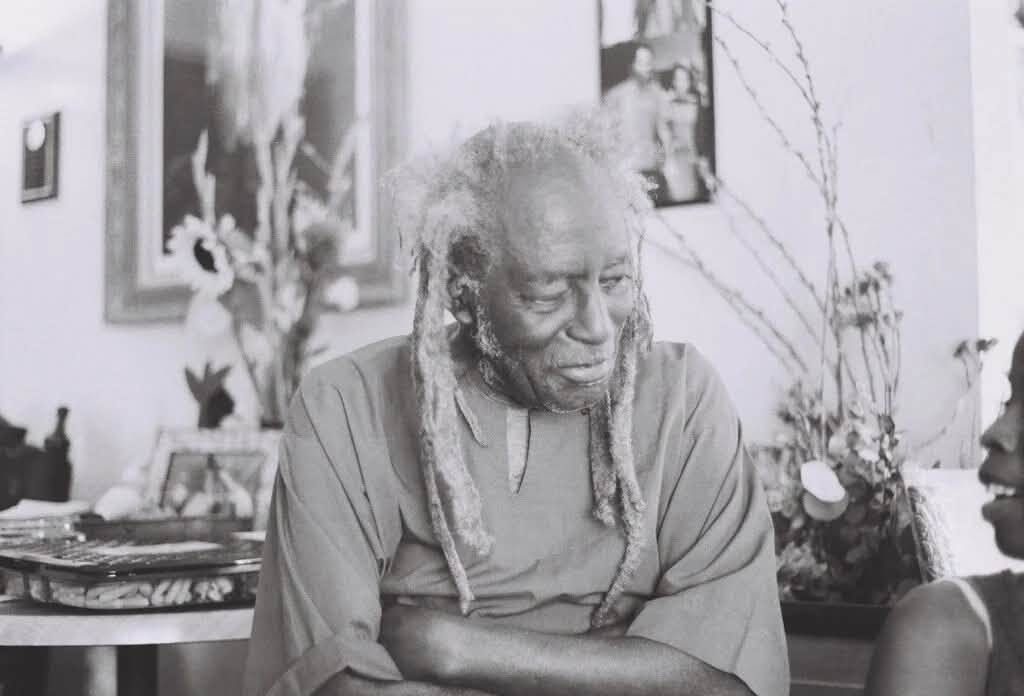

…WPA founder leaves enduring legacy of political activism, scholarship and Pan-Africanism
(Kaieteur News) – Eusi Kwayana, the veteran Guyanese political activist, educator, historian and founding member of the Working People’s Alliance (WPA), died on Saturday at his home in Atlanta, Georgia, United States, aged 101.
He has left behind a political and intellectual legacy that spans the struggle against colonial rule, the fight for social change and decades of political activism in independent Guyana, his party said. “Our elder, teacher, mentor, leader and inspiration has left us to go back to his ancestors. The Sage of Buxton has left this side of the river to return to the source of his spirit. His earthly duty is over. To the very end he kept the faith, cradled the civilization, protected the vulnerable, and empowered the powerless. His loss leaves an empty chair in the gallery of our Guyanese humanity. “It is with deep sadness that the WPA joins with the Kwayana family in announcing the death of Brother Eusi Kwayana. Although we know death is inevitable and that Bro Eusi would eventually leave us, we thought this day would never come. But it is finally here. We give thanks for his life, his wisdom, his guidance and above all, his example. Guyana has lost the last of its original independence visionaries—one of Guyana’s priceless gifts to itself,” the party said in a statement.

Eusi Kwayana
According to the WPA, for 101 years and six months this rare and special spirit walked among us with a deliberate purpose that touched the core of Guyana. The Guyana of the last eight decades is incomplete without the fingerprints and footprints of Eusi Kwayana. Along with others and sometimes alone, he lived the Guyanese decolonization and independence narrative of freedom. WPA declares with certainty that our Eusi was a Founder-Pioneer of our post-colonial order. In him, shone the light of the full flowering of the Guyanese, Caribbean and African fusion.
The WPA said in 1974, Kwayana co-founded the Working People’s Alliance and remained a committed member until his death. Within the WPA, he served as Executive member, Member of Parliament and de facto editor of the party’s organs, Open Word and Dayclean. We remember Eusi as an excellent party organizer and mobilizer. Whenever the party was low on morale, we turned to him for confidence. We also remember him as a loyal party member who never compromised his integrity and independent praxis. It is for that reason that we label him the modern pioneer of the Independent Radical strand in modern Guyanese politics. “While he gave 52 years of service to the WPA, he also laboured in the valley for the original PPP and the PNC in which he served as Assistant General Secretary and General Secretary respectively. He served as a Member of Parliament and Cabinet Member in the 1953 PPP government. In addition to being General Secretary, he served as editor of the PNC’s newspaper, New Nation.”
During the period 1964-71, Kwayana served as head of the National Land Settlement Committee; chairman of the Guyana Marketing Corporation (GMC); chairman of the Cooperative Insurance Committee; and chairman of a committee charged with converting the Guyana Cooperative Credit Society into a Cooperative Bank. “As an Africanist leader, he co-founded in 1961 the African Society for Racial Equality (ASRE), which was dedicated primarily to raising cultural consciousness among African Guyanese. In 1964, he co-founded the African Society for Cultural Relations with Independent Africa (ASCRIA), which, like ASRE, committed itself to the promotion of African pride, dignity, and culture among African Guyanese. He served as Coordinating Elder of ASCRIA and changed his name from Sydney King to Eusi Kwayana, which, in Swahili, means Black Man of Guyana.

A younger Eusi Kwayana during one of his many protests.
He gave everything to his country and his people. Farewell African star, Guyanese treasure and Caribbean wise man. We end this initial statement by calling on Guyanese not to mourn Bro Eusi’s passing, but to celebrate his life and lived journey,” the party stated.
Also in a statement, the People’s National Congress Reform (PNCR)/ A Partnership for National Unity (APNU), described Kwayana as a patriot, historian, elder statesman, and a towering figure in the political and social life of our nation. “Brother Eusi entered the political arena as a youth, dedicating his life to the struggles and aspirations of the Guyanese people. He served the People’s National Congress under the leadership of its founder, Linden Forbes Sampson Burnham, contributing his intellect, energy, and convictions to the building of our Party and the advancement of an independent Guyana,” the party said. It noted that in the years that followed, he continued to serve the nation through the Working People’s Alliance, remaining a fearless and principled voice on matters of governance, justice, and national development. “As a historian, he dedicated himself to recording and preserving our country’s story, ensuring that future generations would know the journey of our people and the sacrifices made along the way.”
According to the PNCR, Eusi Kwayana was more than a politician. “He was a teacher, a chronicler, and a conscience for our nation. His life spanned generations of our political evolution, and his counsel, integrity, and unwavering commitment to principle earned him the respect of friend and adversary alike. The PNCR and APNU extend our most sincere condolences to his family, friends, and all who were touched by his life and work. We join the nation in mourning the loss of an elder statesman, and we pray that his soul finds eternal rest. May his legacy of service, scholarship, and sacrifice continue to inspire us all.”
Enduring politician
In a lengthy tribute, Dr. David Hinds said Kwayana is one of Guyana’s most enduring political figures, a leading Pan-Africanist and a founding figure of the WPA. Kwayana was born Sydney Evanson King on April 4, 1925. “For more than half a century, Kwayana was involved in the country’s political development, moving from the early leadership of the People’s Progressive Party (PPP) to the formation of grassroots African-centred organisations and eventually the WPA. He was also an educator, playwright, author and advocate for Pan-Africanism whose work extended beyond party politics,” Hinds wrote. Born in Lusignan, on the East Coast of Demerara, Kwayana moved with his family to Buxton when he was seven years old. It was in that village, which has played a significant role in Guyana’s political and cultural history, that he developed much of his connection to community life and grassroots organising.

Buxton Sage, Eusi Kwayana
According to Dr. Hinds, Kwayana’s involvement in politics began during the 1940s, when he became active in village affairs. Around 1947, while still known as Sydney King, he joined a group of political activists led by Dr. Cheddi Jagan in establishing the PPP, which emerged as a major force in the struggle for self-government. “The PPP’s victory in Guyana’s first election under universal adult suffrage in 1953 brought Kwayana into government as Minister of Communication and Works. That administration, however, was short-lived. The British government suspended the Constitution in October 1953 and removed the PPP from office amid concerns about the direction of the government and the growing political tensions in the colony. Kwayana was subsequently among those detained by the British authorities in 1954, as the colonial administration sought to suppress what it viewed as a threat of civil unrest.” According to Hinds, Kwayana’s political journey would eventually take him away from the PPP and towards a different vision of grassroots political organisation, race relations and social transformation.
From the PPP to the WPA
Kwayana later became involved in the establishment of organisations dedicated to African identity, cultural awareness and political empowerment. He helped develop the African Society for Cultural Relations with Independent Africa (ASCRIA), a grassroots movement that sought to strengthen cultural and political connections with independent African countries.
ASCRIA became an important part of the political organising that preceded the formation of the WPA. In 1974, the organisation merged into the WPA, bringing Kwayana into a political movement that challenged the established political order and called for broader participation by working people in the country’s affairs. The WPA developed as a multiracial political movement with a strong emphasis on democratic participation, social justice and the organisation of ordinary citizens. Kwayana became part of its collective leadership and worked closely with historian, academic and political activist Dr. Walter Rodney. Rodney’s political activism and the WPA’s mobilisation attracted considerable attention during the 1970s and 1980s, a period marked by intense political tensions and competing visions for Guyana’s future. Kwayana remained associated with the movement through years of political struggle. In 1985, he was elected to the National Assembly as the WPA’s sole parliamentary representative, taking his place in Parliament during a consequential period in the country’s political history.
His involvement in politics was not confined to parliamentary work. He was part of a generation of activists who used community organising, public discussion, writing and cultural expression to advance their political ideas.
An educator committed to Buxton
Hinds said long before his later political prominence, Kwayana had entered the teaching profession. He became a primary school teacher at just 15 years old, an early indication of the role education would play throughout his life. In 1956, he founded County High School in Buxton and became its principal. The institution was later renamed Republic Cooperative High School. “His work in education reflected a commitment to developing opportunities for young people and strengthening community institutions. His connection to Buxton remained an important part of his identity, and the village featured prominently in his writings and reflections on Guyana’s social and political development. Kwayana’s life also demonstrated how education, culture and political participation could intersect. He did not limit his contribution to the classroom or the political platform; he used literature and theatre to explore questions of identity, history and social change.”
Dr. Hinds said Kwayana was a prolific author whose published works addressed some of the most consequential questions in Guyana’s history, including race relations, labour struggles, colonialism and the development of political movements. His books include The Bauxite Strike and the Old Politics, Scars of Bondage, Guyana: No Guilty Race, Buxton in Print and Memory, Morning After and Genesis of a Nation: The Indo-Guyanese Contribution to Social Change in Guyana. He also documented the final period of Rodney’s life in Walter Rodney: His Last Days and Campaigns, preserving an account of the political activism and campaigns surrounding one of Guyana’s most influential and controversial political figures.
His writing reflected a sustained interest in the forces that shaped Guyanese society and the relationships between race, class, culture and political power. Kwayana also made a contribution to the performing arts. His play, The Promised Land, performed by a young cast from Buxton, won the Best Play prize in the Youth Category at the British Guiana Drama Festival in 1965. His involvement in theatre demonstrated another dimension of his public life, using creative expression to engage audiences with social questions and the experiences of ordinary people. In a distinctive contribution to the country’s political culture, Kwayana also wrote lyrics for party songs associated with Guyana’s three leading political parties — the PPP, the People’s National Congress (PNC) and the WPA.
A life spanning a century of change
Kwayana’s personal life was also closely connected to his Pan-Africanist outlook. In 1968, he met Tchaiko Kwayana, an American Pan-Africanist and civil rights activist formerly known as Ann Cook. The two married in Georgetown in 1971, incorporating Yoruba rites into their wedding ceremony. Tchaiko became involved in his organisational work and shared his interest in Pan-Africanism and political activism. She died in 2017. In 2002, Kwayana retired from active public life and moved to California in the United States. His life covered a remarkable period in Guyana’s history, from British colonial rule and the early movement for self-government to independence, the emergence of competing political parties and the struggles over democracy, race relations and economic development that shaped the post-independence era.
Kwayana’s political path crossed with some of the most consequential figures and movements in the country’s modern history. Yet his contribution extended beyond his association with political leaders and organisations. Through teaching, writing, theatre and community organising, he helped document and shape debates about the kind of society Guyana should become. His death at 101 marks the passing of a figure whose life was closely intertwined with the country’s political evolution. His writings, educational work and record of activism remain part of the historical record of Guyana’s long and complex journey from colonialism to independence and beyond.
Source: Kaieteur News



