




Last Updated on Wednesday, 7 October 2026, 20:18 by Writer
The Commission of Inquiry (CoI) into the sinking of the MV Barima ferry has been consulted as part of the government’s evaluation of the bidders for salvaging the vessel, one of the five-member team said Wednesday.
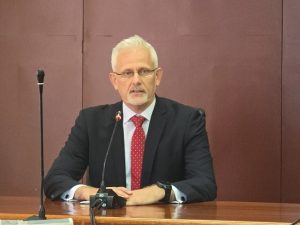
Inquiry Commissioner Dr. Andrzej Jasionowski of Poland, who is a naval architect and marine engineer, told a press briefing after the formal opening of public hearings that he met with a preferred salvage team to discuss the salving and “process of evidence preservation.”
Dr Jasionowski said he was informed that negotiations and conclusion of that undertaking were ongoing, but that would be concluded in a few days to make way for salvaging to begin in October.
“The salvage operations will commence, possibly this month and we will be informed of the progress and all the steps along the way,” he said.
The bidders are Industrial Fabrications Inc. (InFab), BK International Inc and the Netherlands-headquartered KMS B.V.
The Polish marine engineer also sought to assure that although the wreck was on the seabed since it sank on July 18 about 10 miles off Essequibo Coast, the evidence would still be of forensic value to the inquiry.
“Regarding the forensic value of salvage, notwithstanding the few months, two, three months that has (sic) passed, will be, if I may use a quantification, near 100 percent. The ship will give us clues that we seek on its state as it sank. It is made of steel. The cargo is still within the confines or most of it, so the forensic value will be there almost in its entirety. The time will have very little effect on any degradation, in my view,” he said.
Another inquiry commissioner, retired Rear Admiral (Ret’d) Hayden A. Pritchard added that not all of the commission’s work was “hinged on whether this vessel is retrieved or not.”
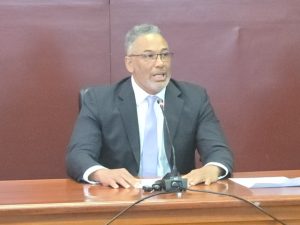
The Chairman of the MV Barima Commission of Inquiry, Justice Godfrey Smith, says the probe will examine the seaworthiness of the vessel relating to its physical condition, stability, machinery, maintenance, certification, inspection, operational condition and compliance with safety and other regulatory requirements.
The probe would also focus on the circumstances and methodology by which passengers boarded the vessel and cargo was loaded.
Questions concerning passenger numbers, manifests, cargo quantities, cargo placement, loading procedures, stability, carriage of potentially hazardous material, availability and adequacy of life-saving equipment, and compliance with regulations will all be inquired into, he said.
Justice Smith says its recommendations will not be legally binding but the commission was not mandated to deal with compensation. “That is not part of our terms of reference. I can say to you that we certainly have no power to make any awards, to order any compensation,” he said.
“Our recommendations are not legally binding, and it will be for the government or other relevant public bodies and organisations to decide what action will be taken in response to our report,” he said in a statement to the first public sitting of the five-member CoI.
Justice Smith, a former judge of the Eastern Caribbean Supreme Court, said the report of a commission of inquiry may be the “catalyst for civil and criminal proceedings to follow.”
Potentially, the CoI will recommend a massive overhaul of the regulatory, legal, technological and human resource functioning of Guyana’s maritime sector.
Justice Smith, who is also Belizean journalist, said the recommendations for reforms will be for strengthening maritime safety and preventing a recurrence.
The MV Barima sank on July 18, en route from Georgetown to Port Kaituma with 179 passengers and crew members.
He said when the inquiry is complete, Guyana should know more than simply what happened when the vessel went down off the Essequibo Coast.
“We will, therefore, be looking at identifying and recommending legislation and regulations that may require amendment and strengthening, instiutional responsibilities that require clear delineation and enforcement, policy changes that must be implemented, training and certification that may be needed and how emergency response arrangements can be improved and any infrastructure and systems that may, over time, need to be put in place,” he said.
He did not rule out making certain recommendations “in the interest of public safety”, ahead of its final report to President Irfaan Ali.
“If, through this inquiry, we can identify the causes of this tragedy, expose the weaknesses that permitted it to happen, recognise the failures that contributed to it, and recommend measures aimed at making Guyana’s maritime transportation system safer, then we will have discharged an important part of our responsibility entrusted to us,” he added.
Source: Demerara Waves



