



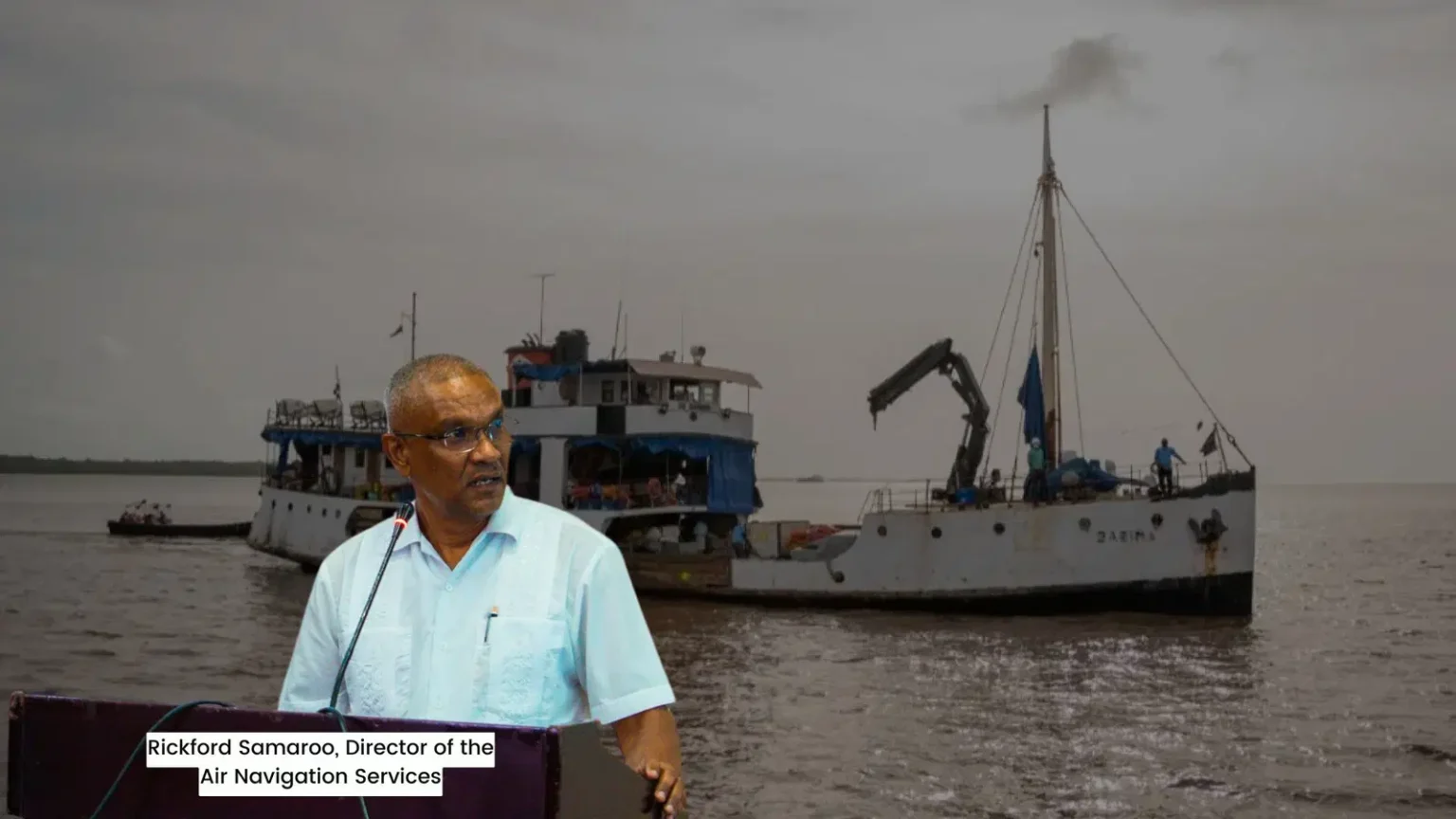

The emergency beacon aboard the MV Barima was not registered, the Commission of Inquiry into the ferry disaster heard on Wednesday, meaning its identification code could not be matched to registration records containing details about the vessel, its owner and emergency contacts.
Rickford Samaroo, Director of the Air Navigation Services Department at the Guyana Civil Aviation Authority (GCAA), also testified that distress alerts began arriving at 10:43 p.m. on July 18, but staff were not required to notify him immediately of signals involving a vessel.
He became aware of the incident only after receiving a call from the authority’s Director General at around 1 a.m. on July 19 – more than two hours after the first alert.
The Director General told him that a vessel might be in distress and that approval had been given for two aircraft to investigate.
Samaroo’s evidence, given as public hearings opened at the Arthur Chung Conference Centre, brought the handling of distress alerts into focus as the Commission examines the circumstances of the MV Barima’s capsizing and sinking almost three months ago.
An emergency beacon transmits a distress signal to help search and rescue authorities locate people in danger. An Emergency Position-Indicating Radio Beacon, or EPIRB, is the type used in maritime emergencies. It transmits on the 406 MHz frequency through the international Cospas-Sarsat satellite search and rescue system. Depending on its design, it can be activated manually or automatically.
Registration links a beacon’s unique identification code to information that can help authorities establish who needs assistance. That information can include the owner’s details, emergency contacts, a description of the vessel and information about intended journeys. Emergency contacts can also help rescuers establish how many people are aboard and clarify the circumstances of an alert.
An unregistered beacon can still transmit a distress signal and provide location information. What is missing is the accompanying registration record that helps authorities identify the vessel and contact people familiar with its movements.
Samaroo told the Commission that the beacon aboard the MV Barima was not registered.
He explained that Guyana receives distress alerts through an arrangement with the United States Mission Control Centre, as part of the international satellite system.
The alert messages contain information including the beacon’s identification code, the date and time, geographical coordinates and an indication of the reliability of the location.
After receiving the Director General’s call, Samaroo contacted the control tower to advise that the two aircraft had been authorised to proceed. It was during that contact that he learnt of the distress messages received from the United States.
He said staff subsequently advised him that the first signal had been received at 10:43 p.m. on July 18, with several further messages arriving after.
Samaroo distinguished between the procedures for aviation and maritime alerts. Staff were required to inform him immediately of an aircraft distress signal, he said, but there was no equivalent requirement to notify him immediately of one involving a vessel.
According to the briefing he received from staff, the Maritime Administration Department, the GDF Coast Guard and the lighthouse were notified within five minutes of receipt of the alert.
The distinction places two aspects of the response before the Commission: how quickly the alerts were passed to maritime responders, and when senior aviation officials were informed.
The Commission requested the relevant standard operating procedures, an after-action report and the complete record of communications from the first alert through the close of operations on the afternoon of July 19.
Chaired by Justice Godfrey Smith, the five-member Commission is examining the ferry’s seaworthiness and maintenance, loading and passenger boarding, crew competence and the adequacy of search, rescue and recovery operations.
It will also determine whether failures to follow applicable laws and procedures, negligence, misconduct or dereliction of duty contributed to the disaster.
More than 100 witnesses are expected to give evidence. The Commission’s initial two-month timeline has been extended to six months.
Source: NEW ROOMS SITE



