




By Khadidja Bâ
(Kaieteur News) – Months after the catastrophic sinking of the MV Barima, grieving families, survivors, and residents from White Water, Mabaruma, Wauna, and surrounding communities are speaking out against what they say is a profound abandonment by the State and humanitarian agencies.
During community hearings on Monday addressing the disaster, relatives of those lost and individuals who barely escaped the river, voiced deep frustration over unfulfilled promises of financial assistance, systemic neglect, and the absence of sustained psychological counseling.
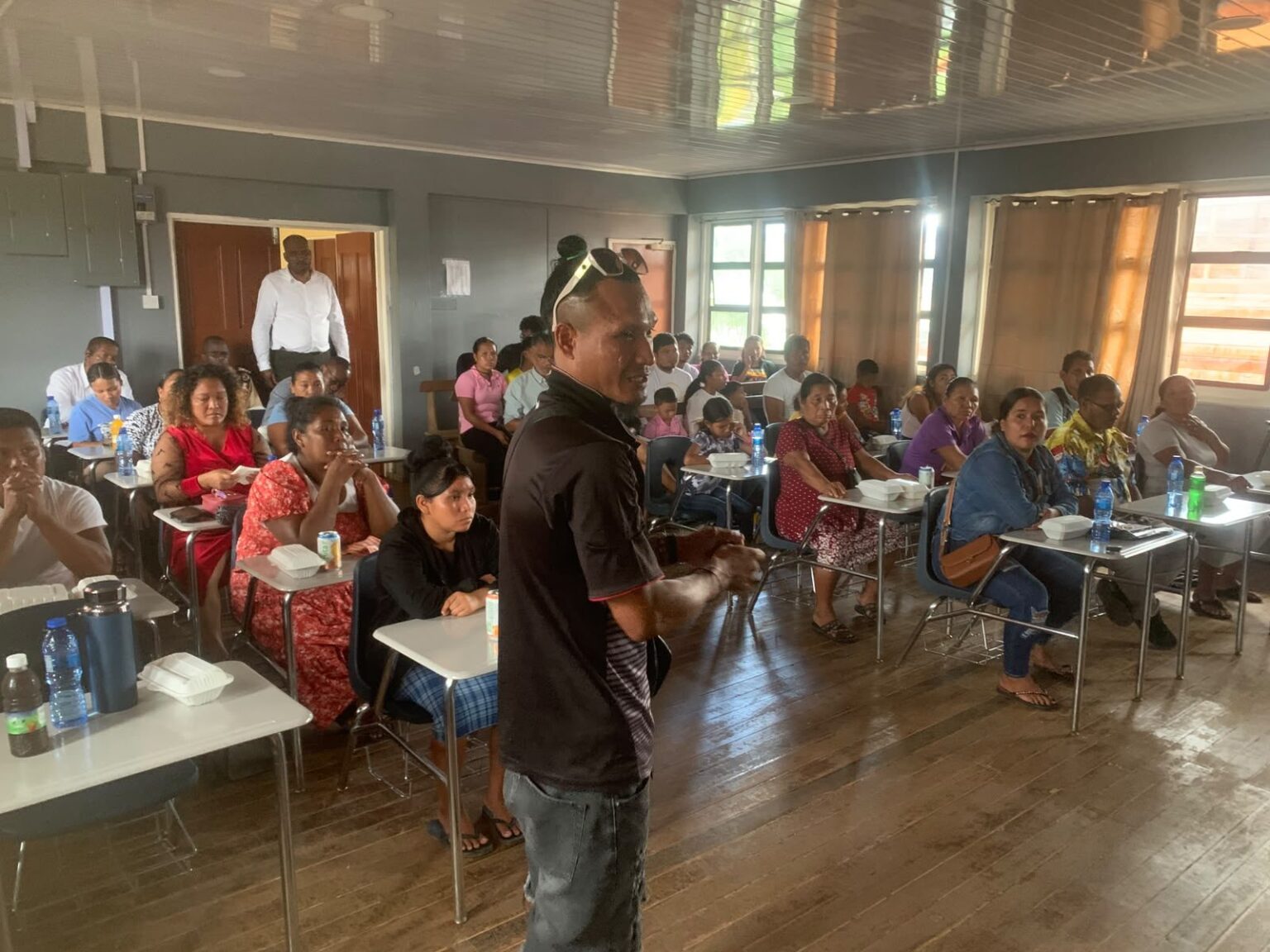
Community members gathered in the NAREI Compound, Kumaka to share harrowing accounts of survival, loss, and the heavy financial tolls exacted by the tragedy. For many families, the burden of traveling long distances to attend hearings and maintain memorials has drained limited resources, while official relief remains elusive. Survivors noted that despite public talk of extensive support packages, families have only received about $6,000 worth of goods and support thus far, leaving them largely to fend for themselves without adequate mental health counseling.

Families speaking with the Commissioners at Kumaka.

“Today is my son birthday…he same one that died… Today is his birthday and I come out here to go and paint his tomb,” shared one grieving father who traveled from the Barima River to honour his young child lost in the disaster. “So, I wish if you all could remind them about the promise, they must not keep it. Because what they’re saying, we hear from the news that millions, a hundred and something million, are all going out to support these people, survivors and losses of family. And no money is coming to you. We don’t know where the money is going. So, you have to remind them for me, sir… Because they’re not coming up the way they’re supposed to be.”
Residents criticised the sluggish rollout of support promised by entities such as the Heart Initiative and government bodies. Expressing the widespread anger felt across the region, resident Eva stated plainly, “The president is failing us.”
Speaking on behalf of affected households, resident Andrew Cox directly confronted the commission regarding the toll the ongoing procedures take on residents:
“The reason why I am raising concerns in the promises and requests and so, is because this is multiple times, you know, police coming to the region, or evening to the village, and would ask the same question over and over. And I think it is being watched. Because in the same question, people come in and ask over and over and over. And it is affecting some of the people as well. Because when they come and question the people, they feel like they are being pressured.”

Families speaking with the Commissioners at Kumaka.
Survivors offered vivid, harrowing recollections of the disaster, detailing a sequence of mechanical failures, extreme overloading, and safety hazards that preceded the vessel’s capsizing.
Passengers recounted that the MV Barima experienced multiple engine failures throughout the journey, stopping around 5:00 p.m. and again at 9:00 p.m. before tragedy struck near 10:00 p.m. Witnesses described a vessel packed heavily with cargo, gas bottles, barrels of fish, generator equipment, and big rollers riding precariously low in the water, with many passengers forced to set up hammocks in overcrowded spaces. Adding to the peril, life jackets were reportedly locked away inside a wooden cage-like structure. One survivor recounted attempting to take her daughter to the washroom downstairs prior to the capsizing, but turned back because water was already visibly pooling below, “I take my daughter for urinating at the washroom. I can’t go downstairs because I see water, and I can’t. I just come back and go outside. And my daughter was so frightened.”

Families speaking with the Commissioners at Kumaka.
Describing the total darkness and immediate panic as the ship went down in mere minutes, another survivor recalled “When my daughter jumped up in the water, she said, ‘Water, mommy, water.’ When we jumped up, a picture, we didn’t have no light, no way. So, the engine had cut off… And then suddenly, the boat came down… No light, no light. Let me jump up and pick up my babies in the dark… In the third black hole… The water cover everything inside.”
She recounted the testimony of a crew member who noticed the rising water level from below, “This boat was sink by water… He keep seeing how the water lodging up. He said, the water not coming off. Like, how it’s lashing and come off. The water just coming up from the bottom. Like he said, the water just coming up, he said. The water coming from the boat bottom, pulling up. So that when the water reach the engine and cut it off, he said, that caps over the boat.” Another survivor detailed the terrifying fight for life after being thrown into the open river, “When I got out of the boat, I saw the boat was totally torn, but when I got out of the water, the boat was completely submerged… We were there the whole time in the water… When we reached, it was quarter past five. They picked us up. Quarter past five. They picked us up from 10 o’clock. We had the whole night in the water. The whole night.”
Rosita Persaud, whose brother Leonardo was traveling to surprise their family, joined others in mourning loved ones lost to the deep waters. Commission representatives attending the hearings acknowledged the grievances, noting the profound fatigue and frustration felt across the communities.
Addressing the inquiries regarding timelines and State promises, COI Chairman Godfrey Smith stated “We are estimating six months. So sometime next year, that would be what? March. That’s what we’re aiming for. We want to work as fast, but as carefully as possible… We are not the government. As I explained earlier, we come from different countries to come and investigate this thing. But what we can do, what I, as the chairman can do, is to pass on a message to say, I came here, and all the people are saying they’re not getting the help that was promised. I can pass that on forcefully, and I will do that.”
Another commissioner emphasised the broader regulatory focus of the inquiry “Our mission is not solely to answer what happened, because what could happen again. So, our focus is a little broader than that… Getting the facts as to why this happened. But just as importantly, doing everything we can to ensure it never happens again anywhere in Guyana… That involves the rules for vessels on your waterways… Limits of how many people can travel on a vessel, and ensuring those limits are respected. Essentially, safety.”
As families continue to pick up the pieces, the demand from White Water, Mabaruma, Wauna, and surrounding communities remains clear, immediate financial relief, genuine psychological support, and accountability for the structural failures that led to the MV Barima catastrophe.
Source: Kaieteur News



