



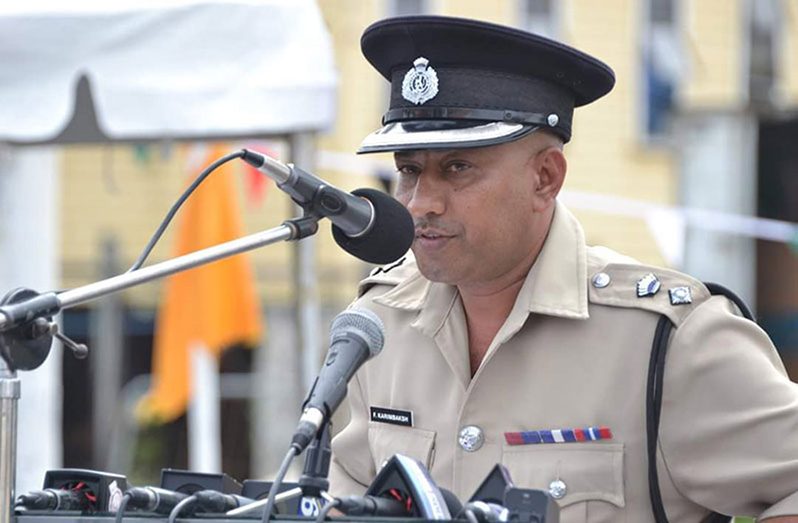

(Kaieteur News) – Deputy Commissioner of Police and head of the Special Organised Crime Unit (SOCU), Fazil Karimbaksh, has formally contested directives from Police Commissioner Dr. Clifton Hicken compelling him to proceed on pre-retirement leave. Through his attorney, Rizwaun Mohamed, Karimbaksh has rejected the legal foundation of the move, warning that immediate legal proceedings will be launched if the directive is enforced without lawful authority.
The dispute stems from a letter issued by Commissioner Hicken on October 7, 2026 (reference A/OPF/760), which stated that Karimbaksh is eligible for 174 days of annualised vacation leave prior to his retirement in April 2027 and that the leave “should commence on 2026-11-08”.

Deputy Police Commissioner, Fazil Karimbaksh
However, legal representation for the SOCU head has fired back, stating that Karimbaksh “does not consent to compulsory pre-retirement leave on the basis presently advanced” and “remains ready and available to discharge his duties and comply with lawful directions”.
The legal challenge centers on both the calculation of accumulated leave and the jurisdiction to enforce administrative absence. According to Karimbaksh’s official records, his actual leave entitlement is 118 days, significantly lower than the 174 days calculated by the police administration. Consequently, the proposed commencement date of November 8, 2026, is expressly disputed.
Furthermore, the legal notice questions the statutory authority behind the commissioner’s directive. While acknowledging that Section 6 of the Police Act, Cap. 16:01, grants command and superintendence of the force to the commissioner, attorney Rizwaun Mohamed emphasised that these powers must align with the constitution:
“A general reliance upon command authority does not resolve the distinct question of the legal basis for compelling my client’s absence.”
The correspondence highlights that Articles 211 and 212 of the Constitution of the Co-operative Republic of Guyana govern appointment and disciplinary powers. Specifically, Article 212(1) vests disciplinary control over officers of Karimbaksh’s rank in the Police Service Commission. While Article 212(2) permits delegation by written directions, the legal notice notes that the commission is presently unconstituted, and stresses that “[a]ny such vacancy does not, of itself, transfer its powers to you or another authority.”
The intervention explicitly rejects the categorisation of the enforced absence as administrative leave, arguing that semantic framing does not bypass constitutional safeguards.
“On the legal basis presently disclosed, you have no lawful authority to impose such leave upon my client. No applicable statutory power or operative written delegation authorising that course has been identified or furnished.”
Dr. Hicken has been placed on notice that if attempts are made to compel Karimbaksh to take leave without lawful backing, legal proceedings will be instituted immediately, including requests for urgent interim relief and costs. Despite the standoff, legal counsel noted that Karimbaksh’s continued performance of his duties should not be interpreted as an acceptance of the disputed leave or a waiver of his objections.
Source: Kaieteur News



