





(Kaieteur News) – ExxonMobil Holdings Corporation in a Securities Exchange Commission (SEC) recently said it paid a whopping US$1.1B in taxes to the Guyana Revenue Authority (GRA) in 2025 as part of its massive ongoing petroleum activities in the country.
The company is now producing about 900,000 barrels of oil per day in the Stabroek Block from four projects – the Liza One, Liza Two, Payara and Yellowtail.
However, the company does not pay taxes to the State as it claimed in the SEC filing. In accordance with the 2016 Production Sharing Agreement (PSA), ExxonMobil does not pay taxes to the GoG. In fact, the sweetheart deal Exxon signed states in Article 15.1 that the contractor (ExxonMobil Guyana Limited) as well as its affiliates shall not be subjected to tax, value-added tax, excise tax, duty, fee, charge, or impost in respect of income derived from petroleum operations, property held or transactions except as specified under the agreement.
Further, Article 15.4 states that the sum equivalent to the taxes owed by the company will be paid by the minister responsible for Petroleum to the Commissioner General of the GRA. The contract also allows for the issuing of a receipt to ExxonMobil, indicating that it has met the local tax requirements to avoid the burden of double taxation.
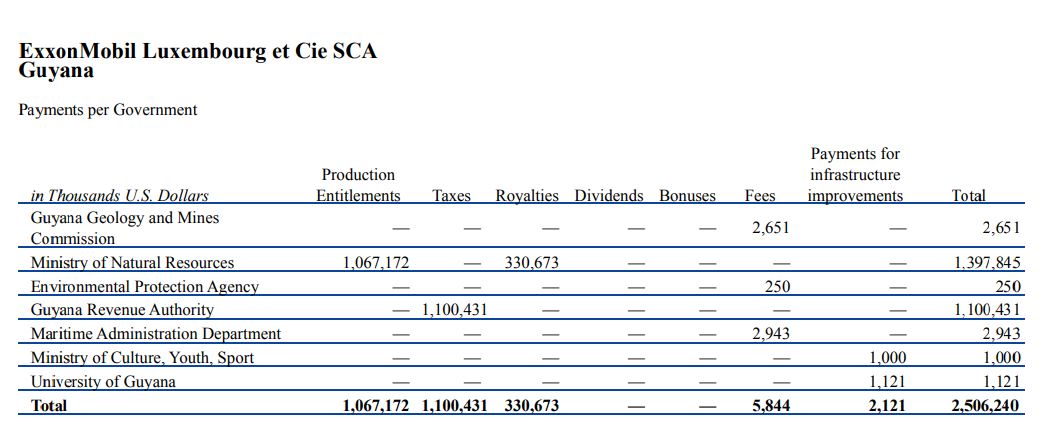
In the report highlighting payments to governments where it operates, Exxon said it paid US$1,100,431,000 to the GRA in 2025.
It also highlighted other payments to the Government of Guyana (GoG), including its production entitlement and royalties which were approximately US$1.1B and US$331M respectively.
Additionally, the company said US$5.8M in fees was paid to the Guyana Geology and Mines Commission (GGMC), Environmental Protection Agency (EPA) and the Maritime Administration Department (MARAD).
A US$1M payment to the Ministry of Culture, Youth and Sport as well as another US$1.1M was documented for the University of Guyana under ‘payments for infrastructure improvements’.
Overall, the company said US$2.5B was paid to Guyana in 2025.
Previously, the former Executive Director the EPA, Dr. Vincent Adams raised concerns over the arrangement which caught the attention of U.S Senators.
“The big issue is that of course it’s not about Guyana, it’s about what they believe to be a loophole that Exxon, even beyond the loophole is very questionable as to whether this is legal or not as to when they submit a certificate that they did not incur expenses for Exxon,” he said.
The former EPA boss noted that it is Guyana’s government that is responsible for paying taxes on behalf of Exxon. The company then presents that receipt to the US government to claim tax credits which amount to billions of US dollars.
“What the senators are saying this here is robbing the taxpayers of the United States of America,” Dr. Adams added.
In September 2025, Kaieteur News reported that three US Senators wrote to the Chief Executive Officer (CEO) of ExxonMobil, Darren Woods about the company’s tax arrangements in Guyana.
In a statement issued to the media, it was explained that U.S. Senators Sheldon Whitehouse, Chris Van Hollen and Jeff Merkley sent a letter on Tuesday to ExxonMobil CEO Darren Woods requesting information on the company’s accounting of its U.S. tax liability as a result of the 2016 Stabroek Block Petroleum Agreement.
“The letter raises questions about whether American taxpayers are subsidising ExxonMobil’s foreign oil production in Guyana, which the company carries out in partnership with a Chinese state-owned company,” the statement said.
It was explained that current U.S. tax rules offer a loophole for big multinational oil companies drilling in a foreign country to shrink their tax bills. “Closing this loophole would save American taxpayers an estimated $71.5 billion over ten years,” U.S officials have said. The senators noted, “We are concerned about the possibility that American taxpayers may be subsidising ExxonMobil’s foreign oil production, which they do in partnership with a Chinese state-owned company”.
The trio made it clear that payments to a foreign government are not taxes and cannot qualify for tax credit.
“Payments to a foreign government in exchange for an economic benefit [such as the right to extract oil and gas] are not considered taxes at all and thus cannot qualify for a U.S. foreign tax credit. However special rules allow ‘dual capacity’ taxpayers to divide up such payments into creditable taxes and non-creditable payments.
Since then, there has been no update on the issue.
Source: Kaieteur News



