(Kaieteur News) – Calling for a sweeping overhaul of global governance, President Irfaan Ali delivered a ringing defence of multilateralism at the 81st Session of the United Nations General Assembly, urging world leaders to transform the UN from a “monument to the past” into an “instrument for the future.”
At the heart of the Guyanese Head of State’s address was an urgent demand to reform the UN Security Council to reflect 21st-century geopolitical realities rather than the post-World War II power dynamics of 1945. Addressing world leaders, President Ali emphasised that a modernised body must embrace the world’s emerging multipolarity, specifically calling for permanent representation for Africa, as well as Latin America and the Caribbean. He cautioned that the current framework, which excludes entire regions from permanent decision-making power, can no longer sustain a just international order.

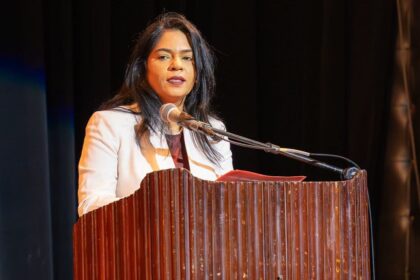
President Ali during his address.
President Ali framed the present crisis confronting global diplomacy as an opportunity for structural rebirth. “If the United Nations is to remain humanity’s best hope, then this is not the hour to retreat from multilateralism,” Ali declared. “This is the hour to reclaim and to renew it. For it is in times such as these, when wars rage across borders, when the shadow of existential threats falls across the future of human civilisation, when the old certainties are dissolving before our eyes, that multilateralism must rise.”
He stressed that lasting security and economic progress depend on shared responsibility, noting that “multilateralism rests upon the proposition that our destinies are bound together, that the security of one cannot be at the insecurity of another, and that in an interdependent world, cooperation is a necessity.” He warned that there can be “no enduring prosperity where inequality deepens, and no just international order where rules are applied selectively.”
To make the institution genuinely fit for purpose, President Ali outlined a comprehensive blueprint focused on institutional governance and efficiency. He called for making the organ “more transparent, accountable and responsive,” while insisting that member states must “strengthen the General Assembly and give greater weight to its deliberative and representative authority.”
Addressing internal administrative hurdles, Ali stressed the imperative to “bring greater coherence to a system too often divided by institutional rivalries, bureaucratic silos and competing mandates,” while simultaneously ensuring that the UN’s financial and operational “resources match the responsibilities we have entrusted to it.”
Closing his address, the President challenged the Assembly to match their commitments with decisive action rather than rhetorical tradition. “Recommitment cannot mean merely repeating the language of yesterday. The world has changed, and multilateralism must change with it,” Ali asserted, urging the international community to forge “a new and invigorated multilateralism, one equal to the turbulence of our age, sufficiently courageous to confront its trials, sufficiently imaginative to navigate its transformations, and sufficiently principled to defend the rule of international law.”
Source: Kaieteur News