



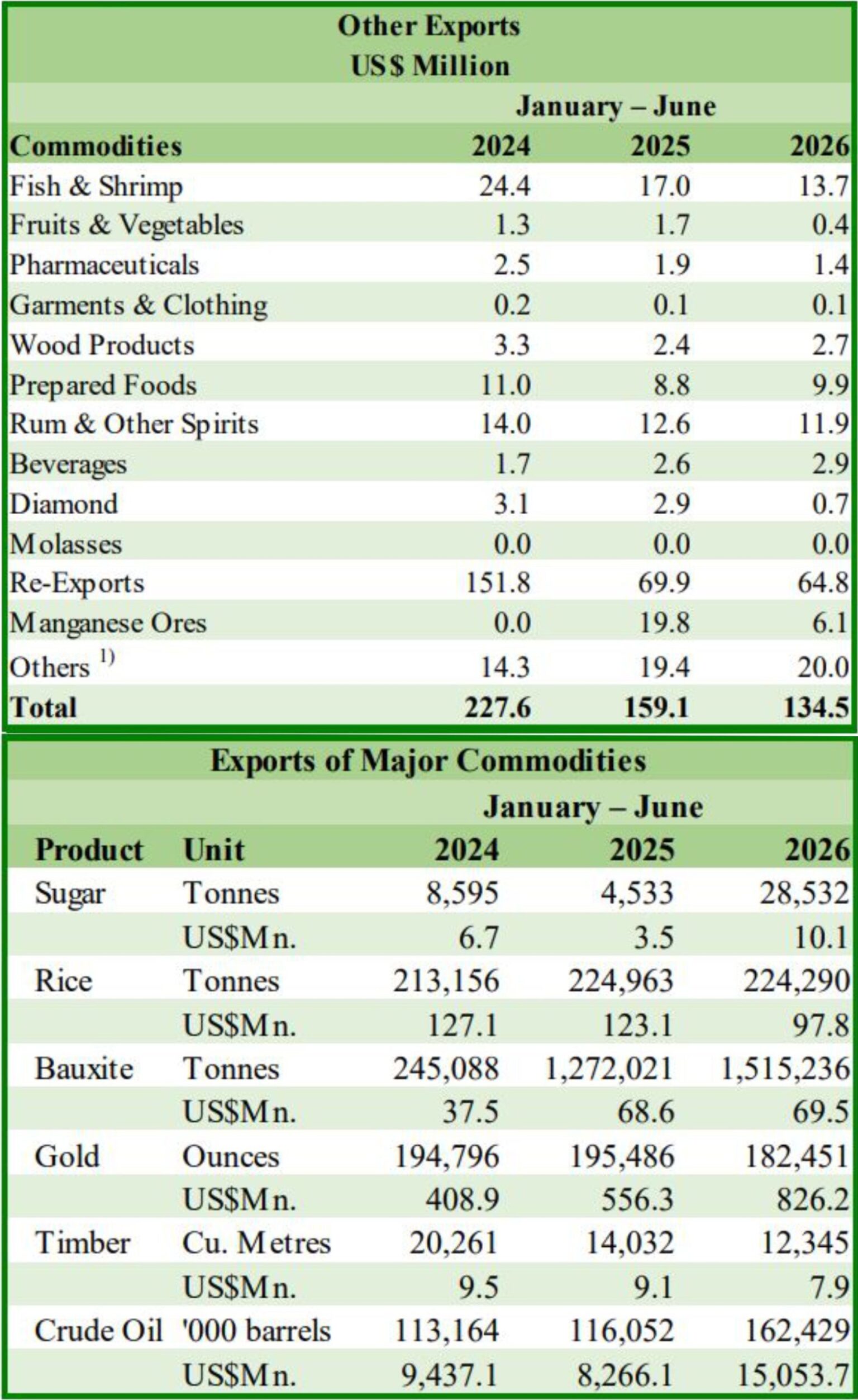

(Kaieteur News) – Guyana exported US$15 billion in crude oil during the first half of 2026, while earnings from non-oil exports totalled just US$1.146 billion, highlighting the vast disparity between the country’s oil revenues and its traditional export sectors, according to the Bank of Guyana (BoG).
According to the report, bauxite export earnings amounted to US$69.5 million; gold exports were US$826.2 million; timber US$7.9 million; sugar exports US$10.1 million; rice US$97.8 million and ‘other exports’ which account for fish and shrimp, beverages, garments etcetera were US$134.5M.
The country’s overall non-oil exports were valued at US$1.146 billion. Of the 18 non-oil sectors, a majority of the subsectors recorded lower earnings. Nine subsectors recorded lower earnings including rice and timber while higher revenues were received for sugar, bauxite and gold.
A footnote in the report explained, “The non-oil primary balance was estimated at a deficit of 35.7 percent of non-oil GDP at end-June 2026.”

Tables showing the non-oil earnings for exports during the first half of 2026 (Source: Bank of Guyana)
The fall in revenue from these traditional sectors has sparked concern among analysts, who previously warned about failing to invest in these crucial areas to avoid falling prey to the dreaded Dutch disease.
The Dutch disease is defined as an economic phenomenon where the discovery of large natural resource reserves leads to a decline in other sectors.
During this year’s Budget debate in the National Assembly, Shadow Agriculture Minister for the A Partnership for National Unity (APNU) Vinceroy Jordan cautioned that the fiscal plan will fail to reduce poverty and strengthen food security because it lacks vision and meaningful investment in agriculture.
Jordan believes that any government serious about decreasing the cost of living would have ensured that each region enacts a sound plan for the development of sustainable agriculture to increase food production and contribute to reduction of the price of food, ensuring food availability and security.
According to Jordan’s analysis of the budget, $1.9 billion is allocated to livestock, with only $200 million to be invested in capital expenditure which caters for new projects, expansion and other such initiatives. On the other hand, $1.7 billion is directed to operational costs such as salaries and other expenses.
To this end, he questioned the ability of this meagre $200M to transform the livestock industry in Guyana. Jordan questioned, “How many bulls, how many livestock farms, how many pens will they build or improve, what sort of equipment could be purchased with $200 million when you still must pay retentions from last year. This is incompetence not agricultural development.”
He continued, “Where are the plans, where are the programmes that would transform the agriculture sector, put food on our tables, and develop the lives and livelihoods of our people?”
GDP growth
Last month, President Irfaan Ali declared Guyana’s economy “healthy” after the country recorded 33.3% real GDP growth at the half-year mark, with the non-oil economy expanding by 10.1%.
At a press conference at the Office of the President, Georgetown, the Head-of-State revealed that Guyana’s revised full year forecast for real GDP growth is now 20.8% while the country expects a 10.2% growth in the non-oil sector by the end of the year.
At the end of June, the oil and gas sector recorded a 41.3% expansion. The bauxite subsector also grew by 7.3% while gold and mining expanded by 11.3%. The President said he was pleased with this growth in light of measures taken by the government late 2025 to tackle the low gold declarations and improve accountability and transparency.
Other mining, which comprises sand, stone, manganese and diamonds is estimated to have grown by 40% during the period.
At half year, the mining and quarrying sector is estimated to have expanded by 40.7%.
In the meantime, the President reported a “marginal contraction” in the agriculture, forestry, and fishing sector during the first six months of this year.
On the other hand, he said that the sugar industry grew by 19.3% at half year; rice also recorded growth of 4.4%.
The other crops sectors however suffered a decline by 6.4%, due to weather conditions according to the President.
Also recording growth were the forestry sector by estimated 15.4%, and the fishing subsector by 4.1% in the first half of a year.
Ali noted too that the manufacturing sector grew by 3%, services sector an estimated growth by 7.2% and the construction sector by 24.7%.
Source: Kaieteur News



